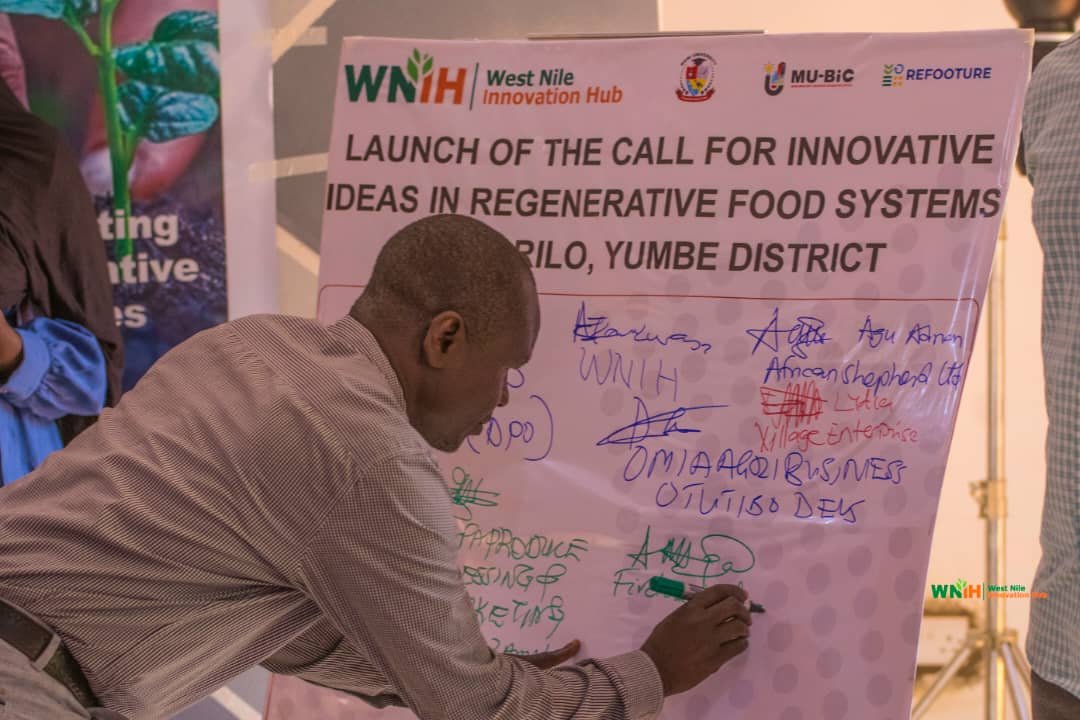
A new chapter of rural innovation began on April 17th, 2026, as the West Nile Innovation Hub (WNIH), together with Muni University, launched an innovation challenge focused on building regenerative and inclusive food systems. The event, held in the heart of the Yumbe community, was not just a ceremony but a declaration that the most powerful ideas for change can grow right from village soil.
The call for ideas brought together 28 participants 18 men and 10 women including the Yumbe District Production Officer, the District Community Development Officer (DCDO), sub-county chiefs, agricultural officers, and entrepreneurship support organizations such as Omia Agribusiness, African Shepherd, Village Enterprise, and Top Land Agricultural Institute, alongside passionate agripreneurs from the Arilo community.
Innovation Rooted in Nature
From the very start, the message was clear: innovation here is not just about high-tech gadgets. It is about redefining the journey of food from the ground to the plate. It is about protecting earthworms that enrich the soil, ending harmful practices like bush burning, and managing polythene waste that suffocates gardens. The community was called to see nature not as an obstacle but as their most valuable partner.
The challenge invites ideas across six critical themes that affect daily life in Arilo:
Water stress (drought and flooding)
Nutrition challenges
Deforestation and land degradation
Livestock and resilience
Access to inputs and extension services
Post-harvest losses and market access
Uplifting Each Other, Owning the Future
A powerful spirit of unity and shared responsibility filled the room. Mr. Andemani Austine, the DCDO of Yumbe, gave a stirring message about the power of community.
"The heart of transformation lies in uplifting one another," he said. "When one person rises, they pull others up with them. Empowerment becomes contagious."
He praised the Arilo community as the "flagship," noting that the initiative proved innovation can thrive in rural settings when people are empowered to become the authors of their own transformation. He highlighted that the preceding activities innovator and ecosystem mapping, a mini community co-creation workshop, and inspirational visits to various innovation spaces were seeds planted in fertile ground.
Open discussions brought practical challenges to the table. Farmers talked about the pain of seeing cattle destroy crops, a problem that breaks trust between neighbors. The production officer guided the community through conflict resolution procedures, reframing the challenge as an opportunity to turn conflict into collaboration through better grazing practices.
The conversation also touched on leadership and governance. Participants noted that bylaws exist to protect communities, but when politicians undermine them to secure votes, the system weakens. Innovation here means reimagining governance where laws are respected, individuals take responsibility, and neighbors hold each other accountable.
A Community as a Think Tank
The official launch was made by the District Production Officer, who thanked the innovators for proudly identifying as farmers. "Feel good that you are putting food in people's stomachs," he said. He urged the community to look beyond the project's timeline and to own the initiative as a permanent "think tank," adding that the district stands ready to support farmers who embrace these opportunities.
He reminded participants that Yumbe was once a food basket, noting that shortcuts like charcoal burning have taken a toll. "Each individual has different innovations," he said. "Let us work together and look beyond Muni. It started in Arilo you are the flagship."
The Path Forward
The vision is clear: transforming Arilo and spreading impact beyond. By documenting successes, sharing stories, and building partnerships, the impact can ripple outward first to neighboring villages, then to the wider region. The West Nile Innovation Hub realized that rural communities across the world are finding new ways to thrive through digital hubs, cooperative farming, renewable energy projects, and youth-led enterprises. Arilo's journey is now part of this larger movement.
Selected innovators will receive support to bring their ideas to life, proving that the seeds of a regenerative future are already being planted by the very people who will harvest them.